VPN Private Network
SD-WAN enables geographically distributed sites, such as branch offices, headquarters, and data centers, to communicate securely over the Internet as if they were connected to the same private network.
This is achieved through a Virtual Private Network (VPN), which establishes encrypted tunnels between sites across the public Internet. The VPN protects data in transit and allows resources hosted at different locations to be accessed securely.
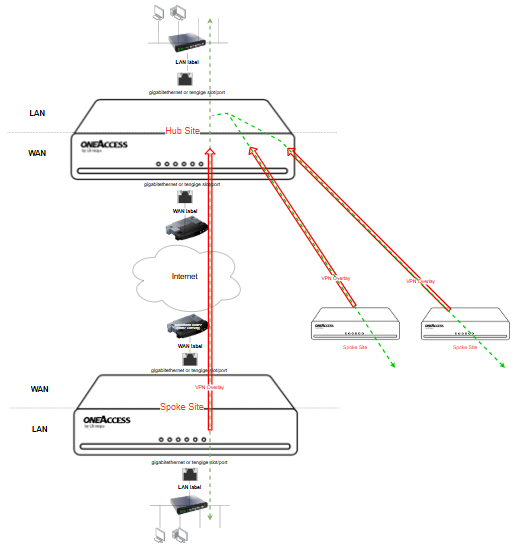
The standard VPN deployment model is based on a hub-and-spoke topology.
In this architecture:
The hub acts as the central VPN concentrator.
The spokes establish VPN tunnels towards the hub.
Spoke sites can communicate with resources hosted at the hub site.
Spoke sites can also communicate with other spoke sites through the hub.
A common deployment consists of branch offices acting as spokes and a data center acting as the hub. However, any site can be designated as a hub depending on the network design requirements.
To enable inter-site connectivity, a VPN overlay (Hub & Spoke) must be created and associated with the sites that need LAN-to-LAN communication.
The following example illustrates a VPN Private Network topology.
 |
Licensing Requirement
VPN overlay functionality requires an SD-WAN Xpress license.