Configuration Objects
An SD-WAN network is designed and operated through a set of configuration objects that describe how traffic enters the network, how it is classified, which overlay it uses, how WAN links are shared, and where policies are enforced. These objects provide the logical structure that allows administrators to translate business requirements into repeatable network behavior.
In this chapter, you will learn more about the key configuration objects used to build and operate your SD-WAN network:
Routers, which provide the underlying connectivity at each site
Sites, which represent the physical locations where your network is deployed
Labels, used to map configurations to LAN and WAN interfaces
Traffic Rules, which define how network flows are identified
Overlays, which determine how traffic is transported across the network
Overlay Traffic Policies, which define how traffic is handled within an overlay
Strategy (formerly Link Sharing Policies), which control how traffic is distributed across available WAN links
Link Sharing Weights, which define how traffic is prioritized during congestion, give more capacity to higher‑priority traffic.
Each object has a specific role in the configuration model. Routers provide the forwarding points. Sites organize routers by location or function. Labels make it possible to target groups of elements without duplicating configuration. Traffic Rules classify flows. Overlays define the logical WAN paths available to those flows. Overlay Traffic Policies map classified traffic to the appropriate overlay. Strategy (formerly Link Sharing Policies) determines how links are used within that overlay, while Link Sharing Weight influences the distribution of traffic across eligible links.
How do the objects fit together?
At the Customer level, you create the main objects used to configure the tenant’s SD-WAN service. These objects include Labels, Traffic Rules, Overlays, and Sites. They define how the SD-WAN network is organized and how traffic is handled across the tenant’s sites.
Traffic handling is controlled through the relationship between Traffic Rules, Overlays, and WAN Labels. A Traffic Rule classifies a flow. The Overlay determines the logical WAN domain that can carry that flow. For each Traffic Rule on an Overlay, a Strategy (formerly Link Sharing Policies) and Link Sharing Weight define how traffic is distributed across WAN links identified by their labels. Current releases also support performance-based policies, which continuously measure WAN link quality and use those measurements when selecting paths.
A typical configuration sequence is:
Labels → Traffic Rules → Overlays → Sites
In this sequence:
Labels are created first so they can be assigned to WAN links and used by policy.
Traffic Rules are defined to classify application or network traffic.
Overlays are configured next, including QoS behavior and the WAN link policy for each Traffic Rule.
Sites are created last by associating routers, interfaces, and the overlays available at each location.
This order reflects the dependency between objects. Policies require Traffic Rules and Labels before they can be applied to Overlays, and Sites require routers, interfaces, and overlay assignments before they can participate in the SD-WAN service.
For a visual representation of these relationships, refer to the SD-WAN Configuration Data Model.
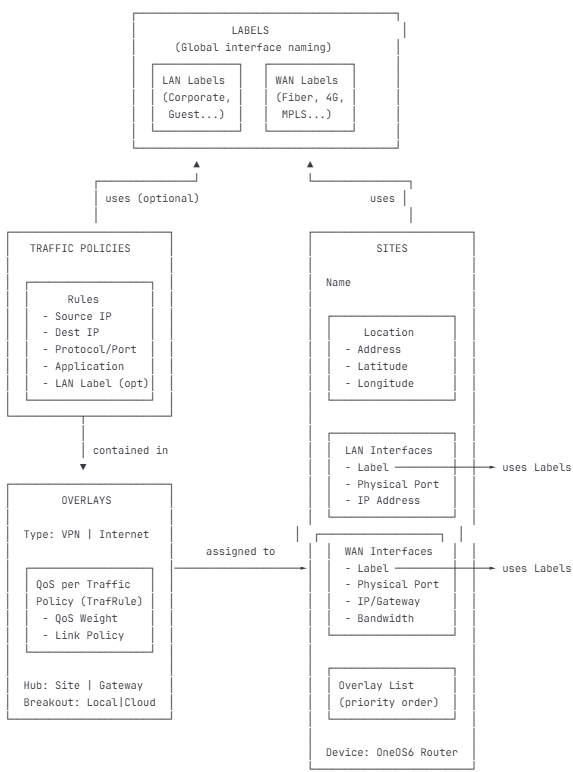 |
The following sections describe each configuration object in more detail.
Object | One-line description |
|---|---|
Router (device) | OneOS6 CPE; assigned to a site from the device inventory. |
Label | Logical LAN or WAN interface name; mapped per site to a physical interface. |
Overlay | Transport path: VPN (hub) or Internet (egress); references Traffic Policies and their QoS on the overlay. |
Traffic Rule | Classification objects containing rules that match flows (IP, ports, app, LAN label, …). |
Overlay traffic policy (QoS / link policy on overlay) | Per–Traffic Rule on an overlay: Strategy (formerly Link Sharing Policies), link sharing weight, steering. |
Site | Location + device + interfaces + ordered overlay assignment. |