Routing extension
In most deployments, user devices are connected directly to the LAN of the SD-WAN router and therefore belong to the same IP subnet.
However, some network designs include an additional IP router between the SD-WAN router and the user devices. In these scenarios, the user devices are located on one or more LAN subnets that are not directly connected to the SD-WAN router.
This architecture is commonly encountered when:
An existing router must remain in service after the SD-WAN router is deployed.
Wi-Fi routers are used to provide wireless connectivity.
An additional firewall is deployed to protect a dedicated network segment or DMZ.
Multiple LAN networks already exist behind a local routing infrastructure.
In these deployments, traffic must be routed between the SD-WAN router and the downstream router to enable access to Internet and VPN resources.
To support this requirement, SD-WAN provides a LAN Routing Extension feature. This feature allows additional LAN subnet routes to be advertised to the SD-WAN domain using either:
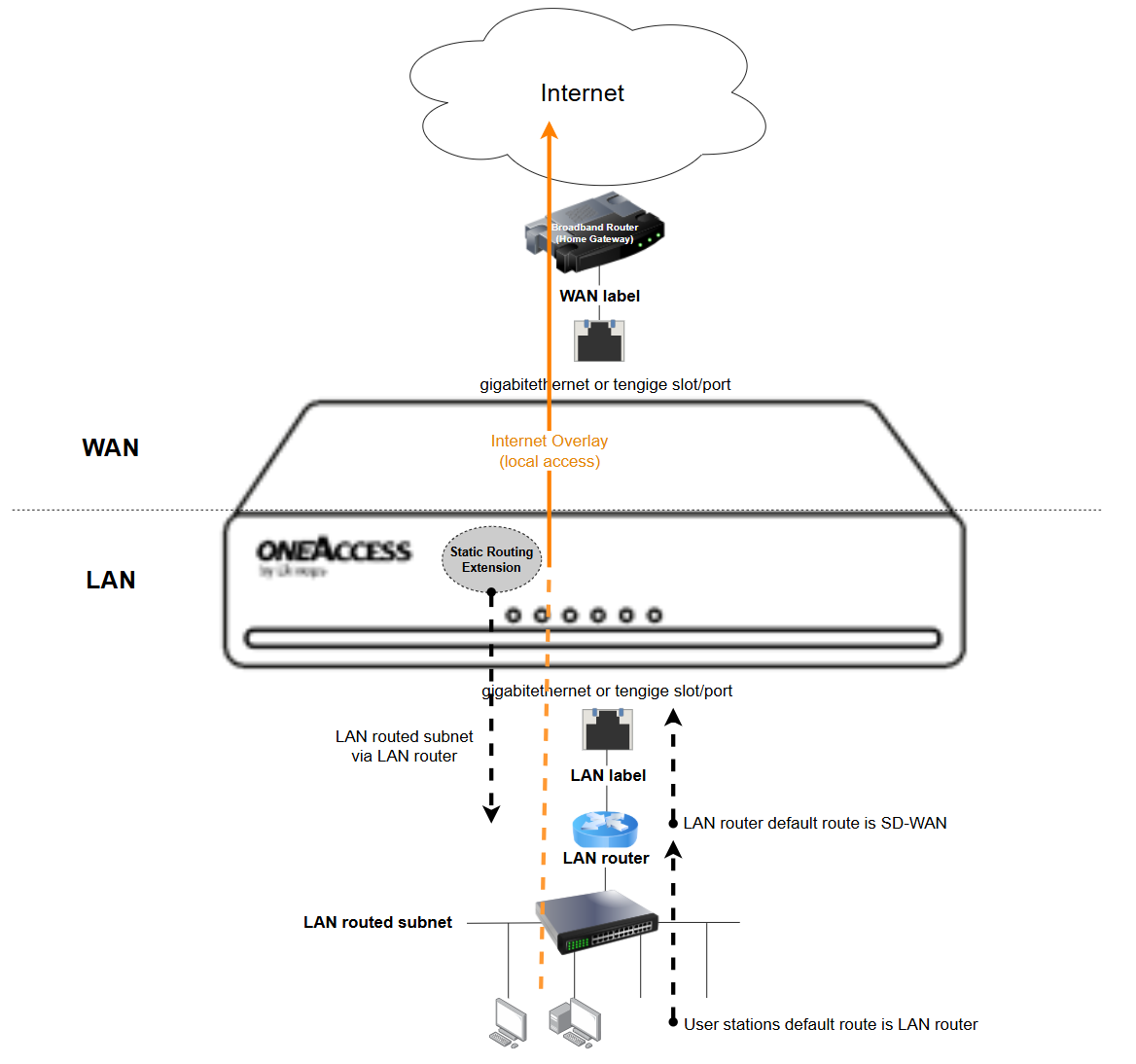
Static routes
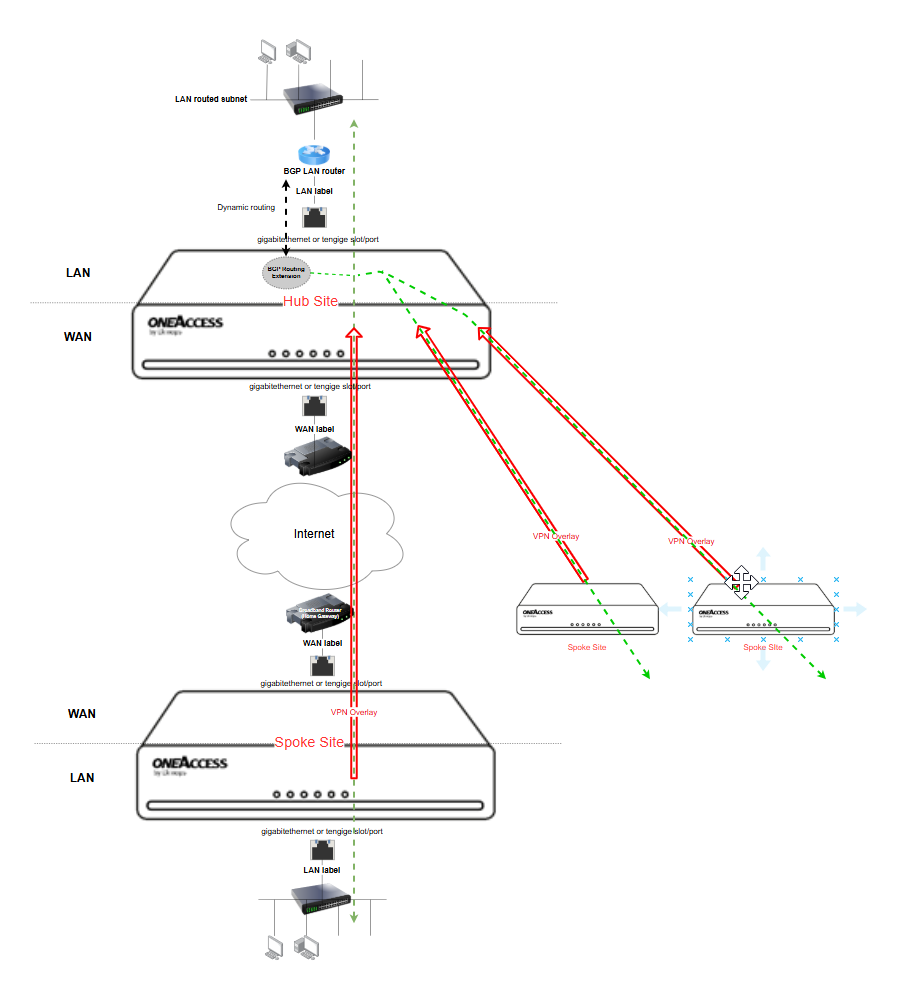
BGP (Border Gateway Protocol)
With static routing, the administrator manually defines the networks reachable through the downstream router.
With BGP, routes are dynamically exchanged between the SD-WAN router and the neighboring router, simplifying the management of larger or evolving network environments.
The following example illustrates a routing extension using static routes.
 |
The following example illustrates a routing extension using BGP.
 |
Once these additional LAN subnets are learned through static routing or BGP, they become part of the network domain.
As a result, devices located on non-directly connected LAN subnets can communicate with:
Internet destinations through Internet overlays
Resources hosted at remote sites through VPN overlays
Services located in data centers or headquarters
When VPN overlays are used, the learned LAN routes are automatically exchanged between sites through the SD-WAN infrastructure, enabling end-to-end connectivity across the enterprise network.
Typical Use Cases
LAN Routing Extension is commonly used when existing routing infrastructure must be preserved or when multiple LAN networks exist behind the SD-WAN router.
This allows the SD-WAN solution to integrate with the existing network design without requiring all devices to be connected directly to the SD-WAN router.