Multi-LAN segmentation with services
The SD-WAN router acts as the gateway between LAN hosts and the services they need to access, whether on the Internet or across a VPN-connected private network.
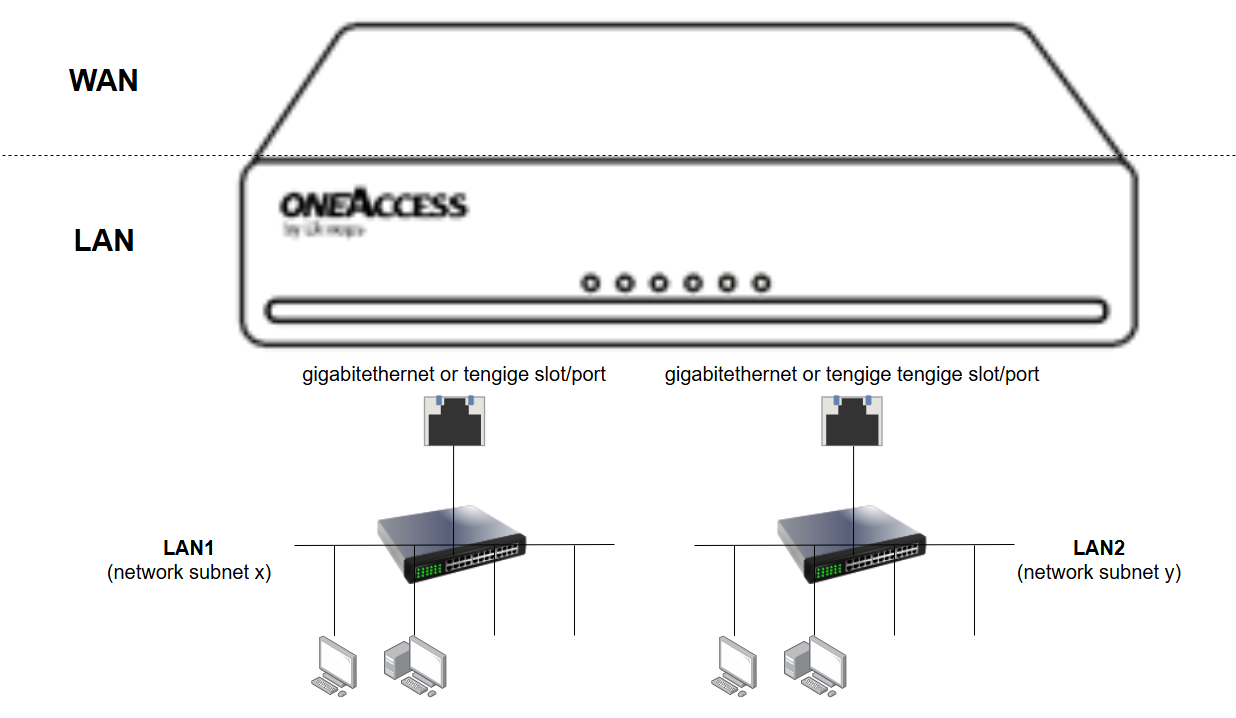
A site can be configured with multiple LAN segments to separate different categories of users or devices. Typical use cases include:
Corporate and guest networks
User and server networks
Voice services
IoT devices
Security cameras
Each LAN segment is assigned its own subnet, allowing traffic and access policies to be managed independently.
The following example illustrates how the DHCP server and DHCP relay work.
 |
As the LAN gateway, the SD-WAN router can also provide several network services to simplify site deployment and management, including:
DHCP Server
DHCP Relay
DNS Proxy
DHCP Services
The Dynamic Host Configuration Protocol (DHCP) automates the configuration of LAN devices by providing essential network parameters such as:
IP address
Default gateway
DNS server addresses
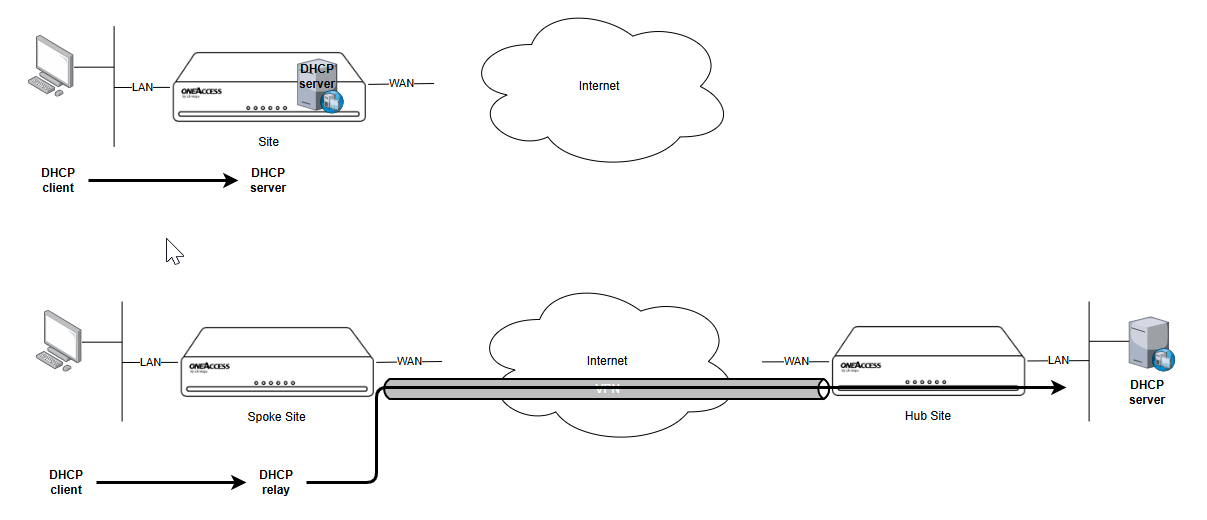
The SD-WAN router can operate as a local DHCP server, allowing devices connected to a LAN segment to obtain their network configuration automatically.
Alternatively, DHCP services can be hosted centrally on a separate server.
In this scenario, the router can act as a DHCP Relay, forwarding DHCP requests received from local devices to the remote DHCP server and returning the responses to the requesting clients.
DHCP Relay is commonly used when DHCP services are centralized at a headquarters or data center site and accessed through a VPN overlay.
The following example illustrates DHCP Relay operation.
 |
DNS Proxy
The Domain Name System (DNS) translates hostnames into IP addresses.
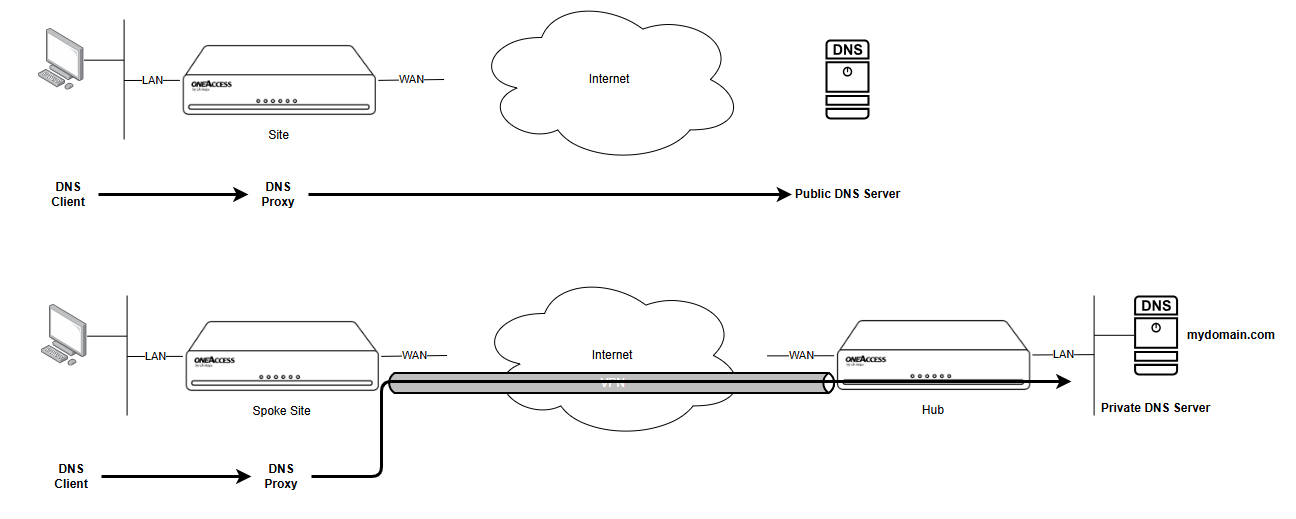
The DNS Proxy feature allows the SD-WAN router to receive DNS requests from LAN devices and forward them to one or more DNS servers.
This capability is particularly useful when an organization uses private domain names that are not resolvable by public DNS services. In this case, the router can forward requests for specific domains to a private DNS server reachable through a VPN overlay, while continuing to use public DNS servers for Internet domains.
DNS Proxy can also be used without a VPN overlay. In this deployment model, LAN devices use the SD-WAN router as their DNS server, while the router forwards requests to designated public DNS servers. This approach simplifies endpoint configuration and can improve performance by leveraging the router as a local DNS cache.
The following example illustrates DNS Proxy operation.
 |
Typical LAN Segmentation Use Cases
Multi-LAN deployments are commonly used to isolate users, devices, and services while maintaining centralized access to Internet and VPN resources.
For example, a site may use separate LAN segments for corporate users, guests, voice devices, and IoT equipment, with the SD-WAN router providing gateway and network services for each subnet.